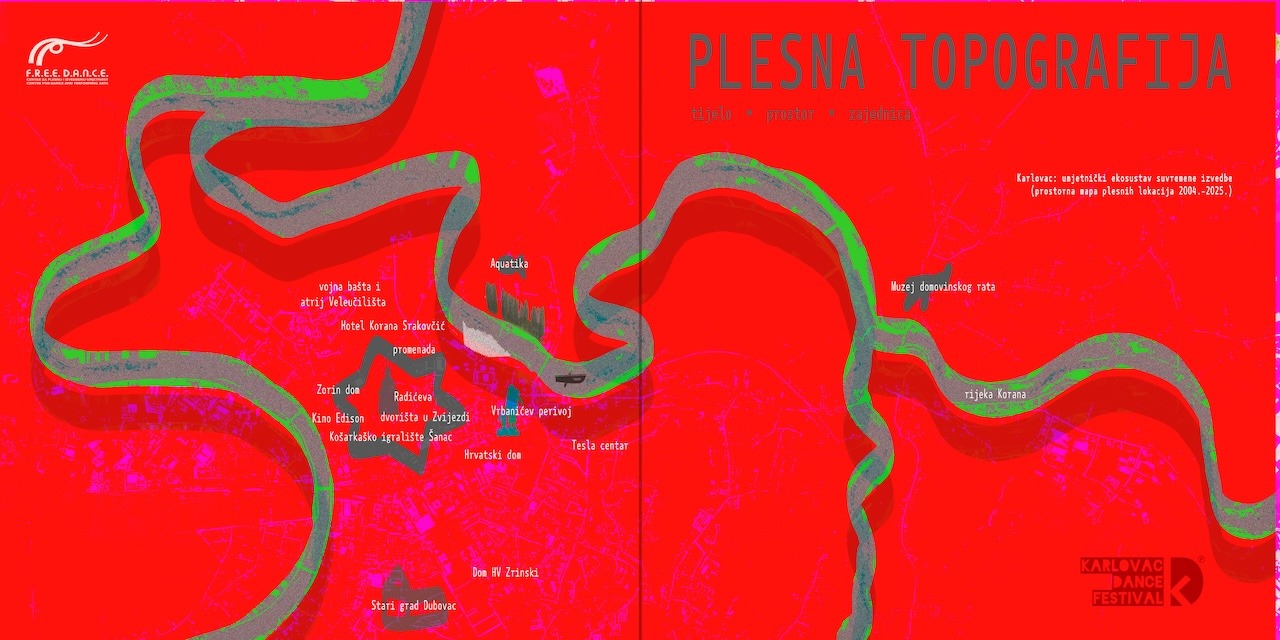
At the heart of Karlovac, our unique story of dance is deeply rooted in over two decades of creative work. The Free Dance Centre for Dance and Performing Arts and the Karlovac Dance Festival (KDF) serve as permanent catalysts for contemporary dance, positioning Karlovac as a prominent point on the map of the European dance scene.
Much like the four rivers that converge in our city, our association and festival bring together diverse artistic expressions, social themes, and educational approaches. In doing so, we challenge the boundaries of traditional perceptions of dance as merely an art form, expanding it into the realms of social engagement, therapy, and the universal right to movement and creative expression.
The name Free Dance was not chosen by chance – it embodies the foundational principles of our work: freedom, diversity, art, education, and participation. These principles deeply permeate every aspect of our operations – from classes and workshops to international collaborations and festival productions.
Our History and Presence: From the Zvijezda to the Atelje on the Korzo
The Free Dance Centre was founded in 2004 in response to the need for a dedicated space to promote, develop, and make dance accessible to various social groups. Our goal from the very beginning has been not only to teach but to cultivate an authentic artistic practice.
Our ideas and initial activities were launched from the Free Dance Info Point, located in the Zvijezda, Karlovac’s historic old town. The Zvijezda remains a vital administrative and informative hub for the association, where our official office and Info Point continue to operate to this day.
Over the years, our educational activities (dance classes, workshops, and dance practices) were held across the city: at the Promenada Club, the ŠAK Dinamic Club, the Small Scene of the Croatian Home, and within the premises of the Karlovac Music School, as well as at various outdoor locations. In 2015, we expanded our performance and educational activities to 15 Petra Zrinskog Street (the Korzo). Since then, our Contemporary Dance Studio (Atelje) on the Korzo has continuously hosted dance education, residencies, rehearsals, and exhibitions.
It was within all these spaces that the concept for the Karlovac Dance Festival gradually matured, leading to its launch in 2011. The festival has since become a vital hub for encounter, dialogue, and the presentation of contemporary dance in its most current forms.
Movement Philosophy and the Dance Ecosystem
The Free Dance philosophy transcends mere technique or style; it represents a holistic approach to dance as a tool for personal and social liberation. Our multidisciplinary approach seamlessly connects dance with other forms of creative expression – from music and visual arts to literature and digital media.
Our programmes regularly address issues of identity, space, knowledge, and ecology, using dance as a medium to initiate social dialogue on vital topics. Our starting point is the development of contemporary dance as a dance ecosystem, where the body functions as the central generator of expression, deeply interconnected with the spaces, places, and activities within the community.
Education, Practice, and the Universal “Right to Dance”
Educational activities form the very core of Free Dance. Our educational programmes cater to all ages and skill levels, from beginners to professionals. The Centre’s dance programmes develop physical and cognitive skills through rhythmics, creative and contemporary dance, improvisation, and dance games.
Students of our Dance School and other educational programmes engage with various dance techniques and elements of theatrical expression. Through this, they develop an awareness of scenic space, partner work, and creative expression. The outcomes of these programmes are frequently presented through productions, performances, and collaborations with cultural institutions.
The value of our educational programmes is further enriched by our dear guests and participants of the Karlovac Dance Festival. In addition to staging performances, they bring their expertise and share their knowledge with participants during festival workshops.
We place a special emphasis on the concept of the “right to dance” – the universal accessibility of dance expression regardless of age, social status, physical abilities, or cultural background. This approach does not view dance as an elite art form, but as a fundamental human right to creative expression and emotional freedom.
Navigating the Challenges of the Independent Scene
Despite our remarkable achievements, Free Dance and the Karlovac Dance Festival face a series of challenges typical for cultural organisations in Croatia. Financial sustainability is a continuous hurdle, particularly within the context of limited public funding and the growing pressure for cultural programmes to be validated primarily by their profitability. Finding a balance between artistic ambition and financial reality demands constant creativity.
Infrastructure challenges also persist – we operate in a city that lacks a purpose-built, adequate dance venue. The modernisation of existing spaces, along with ensuring acceptable technical conditions, is an essential prerequisite for the survival and future development of not only our programmes but contemporary dance in Karlovac as a whole.
Although local financial support for our programmes is modest, it has been present from the beginning and remains important for the formal backing of our work. The efforts of Free Dance and the values of the Karlovac Dance Festival are strongly recognised by national and European bodies. With their support, we continue to make contemporary dance accessible to all, using it as a key tool for personal and social transformation towards a community connected by the universal language of movement.
Meet the Team Behind Free Dance
The Contemporary Dance Artistic Ecosystem in Karlovac
The members and collaborators of Free Dance form a living network of relationships that transcends traditional boundaries between the professional and the amateur, the local and the international, the artistic and the communal. Some joined us as children and remained throughout their youth; some arrived as guests and chose to stay; some discovered a new language through dance, while others shared it with the community. Within this continuous circulation of knowledge, experience, and energy, we create the continuity that forms the foundation of any living artistic practice.