Valuing the potential of contemporary dance to promote well-being, the European exchange project SINIPARKSI was designed to make this art form accessible to a wide audience, while actively promoting the cultural diversity of communities across Europe. Recognising that choreographers and dance teachers need to be better prepared to interact with social diversity, the project focused on developing inclusive training opportunities, guided by two central questions:
- How can a choreographic work be created collaboratively between choreographers and non-professional participants?
- How can cultural diversity become a powerful force for co-creation?
Four European dance companies—based in France, Greece, Germany, and Croatia—re-examined their practices through the work of their choreographers during a co-creation field experiment (co-creation workshop) with local communities from culturally diverse backgrounds. These experiments allowed for the development and testing of an inclusive co-creation methodology. The workshops welcomed a wide variety of participants, including immigrants, refugees, and residents of both rural and urban areas. In doing so, the European choreographers broadened their perspectives, refined their methods, and reflected together on how to create an inclusive dance space.
Through these challenges, the SINIPARKSI project has actively supported the development and dissemination of community arts initiatives that defend cultural rights across Europe. As an integral part of human rights, cultural rights protect the identity, language, and traditions of communities, guaranteeing freedom of artistic expression without discrimination or coercion. By promoting cultural participation for all, SINIPARKSI aims to empower communities and reaffirm the role of dance as a universal language of inclusion.
The knowledge gained from these experiences has been compiled into the SINIPARKSI Training Kit—a teaching guide with accompanying video tutorials designed to help dance professionals foster cultural inclusion in their work. It supports choreographers and dance educators in developing artistic and pedagogical approaches that embrace cultural diversity.
This kit provides tools to adapt choreographic practices to the unique cultural and social perspectives of different communities in Europe, ensuring that dance becomes an accessible and meaningful experience for all, regardless of background or previous experience. It offers choreographers concrete advice for cultivating a sense of belonging, equality, and creative expression, guiding them throughout the process of co-creating a performance—from the initial stages to the final presentation.
In this training kit, choreographers and performing artists wishing to co-create with culturally diverse groups will find:
- Approaches to improve their artistic practice
- Educational tools to initiate the creative process in culturally diverse contexts
- Reflections from participants and choreographers who took part in the challenges

The SINIPARKSI Training Kit is composed of two main resources, offering comprehensive educational support for choreographers and dance teachers:
1.	Written manual
This manual provides an overview of the co-creation workshops, their pedagogical approaches, and the artistic processes implemented. It serves both as a reflective document and a practical guide for professionals seeking to integrate cultural diversity into their practices.
Contents:
o	Choreographers' testimonies: a look back at the challenges and pedagogical developments promoting cultural inclusion.
o	Participants' feedback: the transformative impact of dance on individual and collective well-being, promoting expression and a sense of belonging.
o	Pedagogical proposals: concrete strategies and methods for working with culturally diverse groups.
The written manual of the SINIPARKSI Training Kit

2.	Video kit
The SINIPARKSI Training Kit also includes videos that provide a visual complement to the written manual. These videos feature excerpts from co-creation workshops, dynamic testimonials, and structured analyses, facilitating their practical application.
Contents:
o	Participant interviews: sharing their experiences and the impact of co-creation on their perception of dance and culture.
o	Choreographer interviews: reflecting on their methods, the challenges encountered, and lessons learned from working with culturally diverse groups.
o	Instructional videos: tutorials illustrating specific techniques and methodologies for working with diverse populations. These videos offer practical support, showing how to adapt choreographic approaches according to the cultural context of the participants.
All videos are available with subtitles to ensure wide accessibility.

THE VIDEOS
We invite you to click on the video links to view them.
A. Contact between participants, as movement creation and self-expression, with added value on group cohesion:
1. Use of physical contact, in line with the fundamentals of contemporary dance:
“In Gravity’s Embrace”
A guided exploration of balance and connection through touch, inviting participants to experience the grounding and uplifting power of physical dialogue in a safe, shared space. This experiential tool emphasizes the role of gravity in creating a responsive and safe environment conducive to meaningful connection.
“Awakening the Body Through Touch – An Introduction to the Fundamentals of Contemporary Dance”
In this video, we explore touch as the most immediate and universal sense, a gateway to awakening the body and introducing the fundamental elements of contemporary dance. Through guided physical explorations, participants begin to connect with their bodies, mobilize their joints, and develop an awareness of space and sensory stimuli. This somatic process gradually and organically leads to contact with another body, creating a natural transition from individual awareness to a shared movement experience. Designed for co-creative contexts, this practice fosters inclusivity, embodied presence, and relational awareness within the group.
“The Space Between Us: From Embrace to Dance”
Through improvisation, participants explore how an embrace can change form and meaning: one person may stay while the other moves away, both may wish to maintain the posture, or neither may wish to engage in it. This gesture becomes a terrain for exploring proximity, resistance, consent, and connection, transforming a routine act into a rich field of bodily dialogue and expressive potential.
“In Harmony: Trust and Kindness in Blind Movement”
An exploration of connection, safety, and communication through closed-eye duet movement. This documentary documents a Siniparksi co-creative dance workshop, in which participants explore trust and mindfulness through guided touch and embodied presence.
2. Use of indirect contact to avoid touching and explore all possibilities of contact:
“Gaze: Interacting Through Eye Contact”
Establishing a connection through eye contact in the “Gaze” tool is the first step in connecting without words or direct touch. Connecting through eye contact offers a gentle way to introduce interaction and possible physical contact. Using eye contact as a mode of interaction allows the group to see each participant and allow movement to emerge naturally from this shared connection. This fosters trust between participants and encourages both physical and emotional presence.
“Playing with Voice Sounds as a Source of Physical Inspiration”
The “Playing with Voice Sounds” exercise offers a playful approach to integrating non-verbal sound cues and creating a dialogue between sounds and movements, particularly for a group facing language barriers.
“Bamboo Sticks: Connecting and Caring”
The “Bamboo Sticks” tool allows people to quickly connect with each other through indirect contact.
The use of intermediaries facilitates connection without direct contact. If a partner does not ensure the connection and balance of the object held between them, it falls. Participants are thus forced to care for one another, fostering a sense of group cohesion.
“Trust in Movement: Co-Creating Through Indirect Contact”
This experiential resource offers an engaging exploration of trust, connection, and collaboration through movement, using bamboo sticks as a means of indirect contact. Suitable for dancers of all levels and backgrounds, it guides participants, in pairs or groups, to explore breath, space, and nonverbal connection—developing awareness, attention, and presence without direct contact. It is ideal for dance educators, professionals, and anyone interested in deepening their experience of co-creative movement and connection.
B. Creation of movement, inspiration and creative expression from common everyday references
1. Use everyday gestures
“Why Use Everyday Gestures – Telling a Story”
In this video, everyday gestures and movements are used as a way to remember names and show how they can vary from one culture to another. It also shows how these movements can create a dialogue, tell a story, or set a mood. You will also discover the tool for going from names to movement, called NameMotion.
“Choreography of Everyday Gestures”
Transforming everyday gestures—like walking or looking—into choreography helps bring the group into synchronized movement.
“From Everyday Gestures to Dance – Exploring Embracing”
This video focuses on everyday gestures, such as greeting someone upon arrival or saying goodbye. Using familiar movements like embracing as a starting point, participants are invited to explore how these habitual actions can gradually unfold into dance-like expressions. The exercise encourages experimentation with different ways of embracing and saying goodbye to another body, moving from the known to the creatively unknown. Alongside this physical exploration, attention is paid to the emotional resonance embedded in these simple gestures, and how these feelings can be embodied and integrated into one’s own body language.
2. Use emotions
“Watching a Show: Spectator Emotions as a Catalyst”
Simulating the act of watching a theater performance can serve as a catalyst for choreographic creation. The “Imagine Watching a Show” tool draws on everyday gestures, charged with emotional expression, to generate a sequence of movements.
Emoji Cards: Adding an Expressive Layer
Using emojis as inspiration can be a fun and effective way to generate movement or add an emotional and expressive layer to existing movement. Presenting a mood visualized by an emoji card can help change the quality of dance and provide participants with an opportunity to explore emotional expression.
“Emotions in Motion: Reflecting on Dance Together”
This experiential tool guides participants through a creative reflection process following a dance co-creation workshop. Through drawing, writing, or other forms of artistic expression, dancers explore and share their feelings and experiences from the movement session. Designed for educators, professionals, and dancers of all levels, this tool encourages open emotional awareness and deepens the connection between body, mind, and community.
“Text in Motion: Generating Dance from Emotion and Meaning”
This activity explores how song lyrics or poems can serve as powerful starting points for movement creation. Dancers participate in exercises that involve reading a text with different intentions—emotional, political—and then translating these interpretations into improvised movement. With the theme of love as its foundation, this tool emphasizes the creative process of transforming spoken words into embodied expression, offering rich possibilities for co-creation, storytelling, and meaning-making through dance.
“How to Add Emotion to Movement”
This video explains how adding emotion to a movement can help participants engage their whole body, mimic, and deepen the experience. The choice of starting with movement or emotion is then up to the participants.
“Embodied Meaning – Symbol, Emotion, and the Expressive Dancer”
In this video, we explore the notion of performative presence and how a dancer makes sense of movement. A simple, everyday object becomes a symbolic anchor, inviting participants to project emotional content into their bodily expression. Through this process, movement transcends form to become a conduit for emotion, memory, and imagination. Particular attention is paid to how the inner dancer responds to emerging feelings, and how these internal responses influence the quality, rhythm, and intention of the movement. This practice encourages emotional honesty, poetic transformation, and a deeper connection with one’s expressive self.
3. Use everyday space
“The Bench as a Means of Improvisation”
The “Bench” tool allows participants to explore movements related to a bench and the habitual gestures associated with it. Participants can refer to the normal function of the bench, while transforming this object into something new.
“Using Familiar Space Differently”
This video shows how everyday spaces can help, as participants generally know how to behave in them and can use this knowledge to create material.
C. Creation of movement, inspiration and creative expression from shared or diverse cultural references
1. Artistic references
“From Statues to Self-Directed Movement”
In this video, we see how artistic references can help inspire and offer participants something other than your own.
“How Maps Can Help Participants”
This video shows how visual aids can help participants remember the sequence of scenes and their placement.
“Redirecting Inspiration”
This video shows how to share your own inspiration, how it can be passed on to participants, and how this story can evolve thanks to their contribution.
“The Moving Poem: Exploring Rhythm, Voice, and Movement”
This video captures a co-creative choreographic exploration inspired by poetry, live music, and improvisation. Participants interact with rhythm, spoken text, and movement to develop expressive responses and collaborative compositions. Designed for both professionals and non-professionals, the activity invites dancers to connect voice and body through rhythm, imagery, and shared creativity.
2. References to Collective Memory (i.e., intangible cultural references)
“Cultural References That Connect”
Our collective cultural references—such as native languages, childhood games, ways of greeting each other, personal dream narratives, or places connected to dance—are valuable tools for engaging participants from diverse cultural backgrounds in movement. The dancers’ varied responses bring a rich and unique palette of gestures to the process. This served as creative fodder, allowing participants to feel seen and heard. This personal and cultural input enriched the choreography with a particular emotional depth and authenticity.
“Greetings in Movement: A Co-Creative Dance Tool”
This exercise offers a creative approach to exploring greetings and farewells through dance improvisation. Designed for both professionals and non-professionals, it offers dance educators a flexible tool to foster connection, inclusion, and co-creation within diverse groups. Through simple yet meaningful movement instructions, participants are invited to transform everyday gestures into shared and expressive experiences.
“Childhood Games as Cultural Connectors in Co-Creation”
This video invites participants to discover how childhood games can act as powerful cultural vectors in dance co-creation workshops. By engaging in playful improvisation inspired by these games, dancers are encouraged to explore creative movement and generate choreographic ideas. This tool fosters connection, collaboration, and cultural exchange, making it particularly suitable for diverse groups wishing to deepen a shared creative experience.
“From the playground to the dance floor: the dynamics of a simple game”
An icebreaker that introduces the fundamentals of contemporary dance in a simple way and establishes a space of equality between the choreographer and the participants, reminding them that the fun lies not in winning, but in the game.
“The discotheque: common understanding”
Finding common understanding in cultural diversity, for example around the discotheque, helps participants create their own choreography 3. Common cultural objects “Dancing with coats” The coat serves as a starting point for associations that can be used to create movement material. Guided exploration with such an object allows for storytelling through dance. By discovering the object, its material, functions, or meanings, a collective imagination can be explored. It can serve as a catalyst for storytelling, create connections, and add layers of meaning to the choreography. “Dancing with Symbols: Performing the Invisible” This video explores how a shared cultural object—here, a coat—can become a starting point for embodied expression and group connection. As each person interacts with the object, its physicality becomes a tool for transformation, emotional release, and meaning-making. The coat is no longer just an object, but a shared language—one that allows individual experiences to resonate within a collective context, fostering empathy, cohesion, and creative expression within diverse backgrounds.
D. Choreographers’ feedback and perspectives
“Feedback from each choreographer on their feelings and how this experience enriched them”
The choreographers involved in the project share their feedback on the experience, as well as the feelings it brought them.
“The enrichment of choreographers through experience”
The choreographers involved in the project share their feedback on this experience, and how it enriched them.
E. Participants' feedback on their feelings after the experience and their reflections on this creative opportunity
“Participants’ feelings during the workshop”
After each challenge, participants were invited to share their feelings during the experience
“Personal Growth of Participants”
After each challenge, participants were invited to share their thoughts on this creative opportunity. The video shows what co-creation with a culturally diverse population can bring them.”
Workshop teasers
Siniparksi teaser 1 – Workshop in Briançon
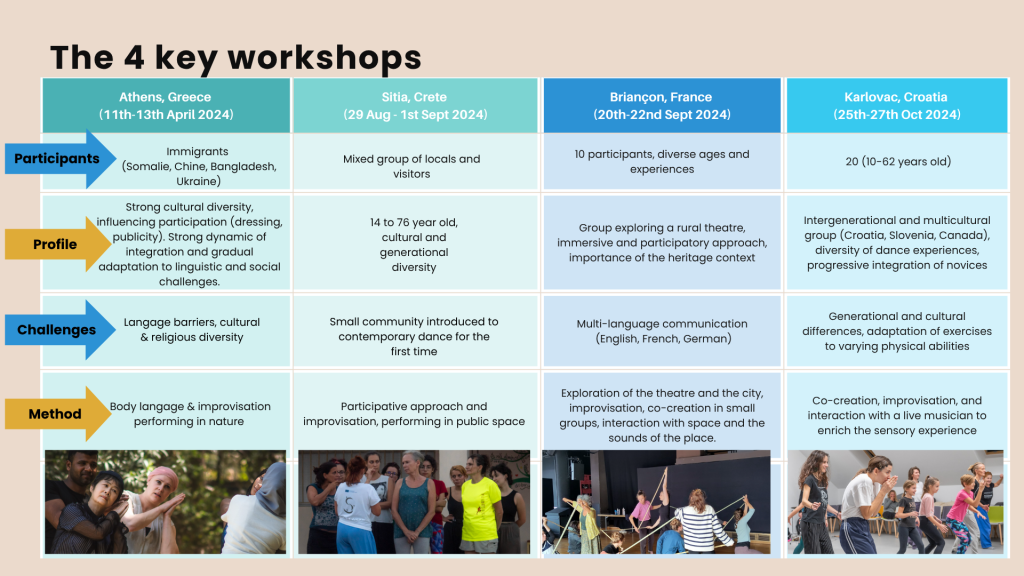
A three-day co-creation workshop took place at the Briançon Theatre, located in a very small town in the rural and mountainous northern Hautes-Alpes region: a site-specific co-creation with experienced dancers.
Siniparksi teaser 2 – Workshop in Athens
A three-day co-creative dance workshop, which took place in Athens, Greece, concluded with a public performance: a workshop with immigrants.
Siniparksi teaser 3 – Workshop in Sitia
A three-day co-creative dance workshop in Sitia, Greece, concluded with a public performance: a first experience of dance in a rural setting, with a performance in a public space
Siniparksi teaser 4 – Workshop in Karlovac
A three-day workshop in Karlovac, Croatia, concluded with a performance on the last day: a first experience of dance with a musician and a theatrical performance.


ACCESS ALL SINIPARKSI PROJECT RESOURCES IN ONE PLACE
Visit the Blog for the latest insights:

The SINIPARKSI training kit blog (in English)
Explore our YouTube channel for fresh insights and Siniparksi Training Kit videos:
YouTube page of Siniparksi training kit videos
Download the Training Kit to start learning:
Funded and Supported by:

“Funded by the European Union. The views and opinions expressed are those of the author(s) and do not necessarily reflect those of the European Union or the European Education and Culture Executive Agency (EACEA). Neither the European Union nor the EACEA can be held responsible for them.”


